

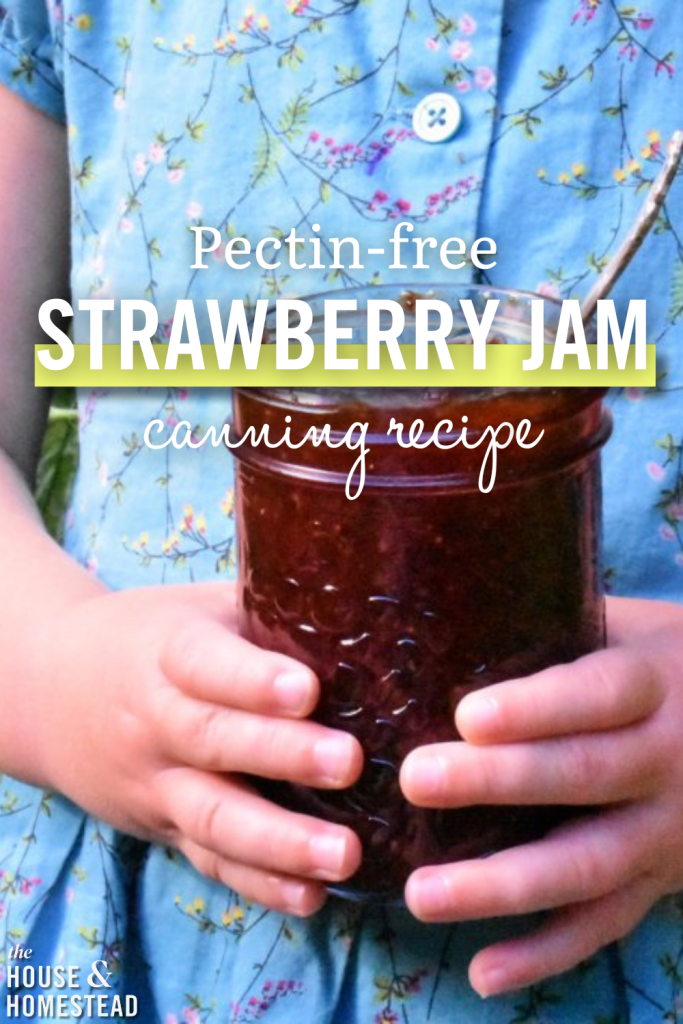
 This pectin-free strawberry jam canning recipe utilizes the natural pectin in strawberries to create a homemade jam that tastes just like summer in a jar. Plus, the optional addition of vanilla makes this classic strawberry jam taste just like a strawberry sundae!
* * *
Nothing says summer like the taste of fresh strawberries picked and eaten right out of the garden. Being the first fruit of the season to appear in most places, strawberries are a symbol of the abundance that lies ahead. And for homesteaders and home canners everywhere, they also mark the official beginning of canning and homemade jam-making season.
Of course, we live in a time when you can pretty much get strawberries year-round at the grocery store. But anybody who’s ever tasted local, organic, fresh strawberries in season knows there’s just no comparison to the store-bought variety for sale in plastic clamshells in mid-January.
Personally I try to eat and feed my family as seasonally, locally and organic as possible, all year round. In the summer we grow a large organic garden of our own and do our best to supplement with produce from other nearby organic farms. But since most fruits and veggies don’t grow locally year-round, I try to also preserve as much as possible. It’s a great way to get us through the year until things are in season again.
Now, I’m not perfect, and we do still rely heavily on the grocery store in the off-season especially. But there are certain items I try extra hard to preserve and put up in season so that I can avoid buying them from the grocery store, and fresh strawberries top the list.
For one, strawberries are on the dirty dozen list, meaning that non-organic strawberries are one of the most heavily sprayed crops when it comes to pesticides. So when I do buy them from the store, I always make sure to buy organic.
But we also grow some pretty damn good strawberries here on Vancouver Island, and I would rather buy local and support our local farmers. Plus, I try to keep pesticides out of our food and save money by buying in season, and reduce our waste and carbon footprint by purchasing local and bringing our own basket (no more plastic clamshells!). I tend to load up on fresh strawberries when they’re in season and preserve as many as possible for eating throughout the year.
Watch: How to Make (and Can!) Pectin-Free Strawberry Jam
If you can’t grow your own, why not pick your own?
Now, you’ll notice I mentioned that we buy our strawberries from local farmers, and that’s because, as much as we strive to grow more and more of our own food each year, strawberries are just not a crop we’ve been able to devote a lot of time or space to establishing yet.
I do have dreams for a cascading strawberry “pyramid” in the middle of our garden one day in the not-so-distant future. But for now, we have a few small pots around our homestead that hardly produce enough for us to eat fresh. So we are still reliant on local growers for our strawberries each year.
But that’s okay, because we’ve made a fun tradition of going strawberry-picking in June when most varieties are ready for harvest. And I’m all about these type of seasonal family traditions.

Just like we visit the pumpkin patch on Thanksgiving weekend (in Canada Thanksgiving is in early October, before Halloween), or go cut down our own Christmas tree at a Christmas tree farm in December, strawberry-picking has become our early summer family tradition, and although I would love to grow enough of our own strawberries to take us through the year, I don’t half mind packing up the family and heading to a U-Pick farm with our baskets in hand 🙂

Eat seasonally and preserve the rest
This year we took home just under 25 pounds of fresh strawberries, in addition to the 10 pounds I’d ordered earlier from another local farm in order to restock our freezer and make a couple strawberry rhubarb pies to kick off summer pie season (which just so happens to coincide with summer canning season;).
We froze a few freezer bags full (because I love having frozen strawberries on hand for smoothies and baking throughout the year), I used some to flavour my latest batch of kombucha, turned some into homemade fruit leather and last but most certainly not least, I canned up 18 jars of homemade strawberry jam with the rest. In fact, if I’m being honest, I made sure to get my 18 jars of jam made first, and then I preserved the rest by freezing, dehydrating and fermenting. But the jam is an absolute must-have every year.
While I do make a few different types of jam throughout the summer, homemade strawberry jam is by far our family favourite, and it’s the kind we go through the quickest. And since we also make all of our own jams and don’t purchase any from the store, I always make sure to make a big batch right after we go strawberry picking in June.
This year I canned up 18 jars so that we have enough to get us through the year, as well as a few extra jars on hand to give as gifts throughout the year. Because you really can’t go wrong gifting somebody a jar of homemade strawberry jam. In fact, I’ve already given two jars away as hostess gifts!
I always use the same recipe, which I’ve adapted from the Ball Complete Book of Home Preserving (referred to often throughout this blog as my “canning bible”).
I also like to add a little bit of vanilla to my recipe because it gives this easy strawberry jam recipe a bit of a “strawberry sundae” twist which really sets it apart from other strawberry jams.

Pectin-free strawberry jam with a vanilla twist
The recipe calls for eight cups of whole, hulled fresh strawberries, six cups of sugar, an optional tablespoon of vanilla extract (or a vanilla bean) and no added pectin. Since strawberries have their own natural pectin, it’s not necessary to add store-bought pectin.
I like to keep things as simple and natural as possible, as often as possible:)
I must admit, the sugar content is still a bit high, and I’m going to try experimenting with jam and jelly recipes with less sugar this summer. But this particular recipe is just so good that I can’t help but stick to the same great recipe year after year. It really is a treat for us, and since we tend to gift a lot of it too, I want it to be a treat for our loved ones as well. So I’ve stuck with a tried and true classic strawberry jam recipe here, with that optional hint of vanilla, of course;)
We tend to go through about one jar of jam every month for our family of three because we do try to keep our jam for special weekend breakfasts and treats like pancakes, waffles and even over vanilla ice cream. But I still think it goes best spread over a slice of warm homemade bread fresh out of the oven.
Or straight out of the jar with a spoon;)

However you like to enjoy your jam, this pectin-free strawberry jam canning recipe will never let you down.
Oh, and if you’re more of a visual learner and would appreciate a video tutorial on making and canning this easy strawberry jam recipe, be sure to check out the following video on my new (again) Youtube channel (and subscribe while you’re at it!!)
Or, as always, scroll to the bottom for your printable pectin-free strawberry jam canning recipe.
Happy canning:)

Pectin-Free Strawberry Jam Canning Recipe
Ingredients
- 8 cups fresh strawberries, hulled and washed
- 6 cups sugar
- 1 vanilla bean or 1 Tbsp vanilla extract (optional)
Instructions
- Prepare jars and lids.
- Mash strawberries until they form a soupy liquid, but keep some nice big chunks of strawberry. I find it easiest to do this with my bare hands! Just make sure they're nice and clean;)
- Pour mashed strawberries into a large, stainless steal pot (be sure to use stainless steal as other metals (such as copper, aluminum or cast iron) are reactive and can give jam a weird flavour.
- Pour sugar into pot and stir well to combine.
- Add vanilla/vanilla bean, if using. If using a vanilla bean, cut it down the centre to expose the vanilla inside and toss the whole thing into the pot.
- Boil on medium-high, stirring consistently until the mixture begins to thicken up (25-30 minutes on average).
- Do a sheet test to make sure jam is thick enough (a sheet test is when you put a spoon in ice cold water and then dip it in your hot jam/jelly mixture quickly, then turn the spoon on its side to see how quickly the jam slides off. The slower, the thicker. If it all comes off in one sheet instead of individual drips, it is definitely the thickness of jam).
- When jam is ready, skim the foam off the top and then fill each hot jar to the top, leaving ¼-inch headspace.
- Using a knife, skim around the inside of the jar to release any trapped air bubbles. Adjust headspace if necessary.
- Wipe jar rims, place lids on top and screw bands on.
- Process in boiling water for 10 minutes, then turn heat off, take lid off and leave jars in canner for an extra 5 minutes.
- Using jar lifters, take jars out of canner and let them cool completely on your counter. Then store in a cool, dark place and enjoy all year long!

Wanna learn how to can your own food?
Whether you’ve never canned anything before or you’ve done a little home canning and you’re ready to take the next step, my Yes, You CAN! complete home canning course will walk you through everything you need to know to get started canning food SAFELY at home.
Over the course of 12 easy-to-follow lessons, we cover both water bath canning and pressure canning, and I show you step-by-step how to can your own jams, jellies, pickles, pie fillings, fruits, vegetables, tomato sauce and chicken stock at home. And of course we’ll go over safe canning practices, equipment and over all best practices in more depth so that you always feel confident both during the canning process and while enjoying your home-canned food afterwards.
You’ll also get a collection of bonuses including:
- Printable checklists and cheatsheets to help you stay safe and never miss a step while canning food at home
- My bonus Jam and Jelly Making Mini-Course to help you make and can your own jams and jellies with store-bought pectin, no pectin and even low-sugar
- A copy of my Home Canning Handbook, complete with 30 of my favourite home canning recipes for canning everything from fruits and vegetables to jams and jellies to sauces and salsa to stocks, soups, meats, combination meals and more!
If you’re ready to get started home canning (or canning more food than ever before this year!) enroll now and get started stocking your pantry!
Related Posts:
- Water Bath Canning for Beginners
- Easy No-Knead Homemade Bread
- Homemade Honey Brioche Bread Recipe
- Sourdough Discard Pancakes
- Low-Sugar Strawberry Jam with Pomona’s Pectin
- Water Bath Canning for Beginners
- 6 Canning Safety Rules You Must Follow
 Wishing you homemade, homegrown, homestead happiness 🙂Save
SaveSave



Do you cover the jars with water when you process them in the pot?
Thank you
Yes, be sure to cover jars with water completely (about an inch or two of water) and then process. Jars should be fully submerged for the duration of your processing time.
Thanks for the vanilla hint. This year I used the high sauté function of my Instant Pot to cook the jam. It kept it at the perfect boil, without scorching. Turned out nice and thick.
Nice! I never thought of making jam in the Instant Pot! I think I might have to give it a try!
How much jam does this recipe yield?
Hi Molly,
This recipe yields about 8 half-pint (8oz) jars of jam.