

 Many of us start gardens for practical reasons—to grow food, herbs, medicine, and become more self-reliant. This is certainly true for us homesteaders who tend to focus most of our gardening efforts on plants that will feed our families and fill our pantries and apothecaries. But one of the major benefits of a garden that we can sometimes overlook is its ability to feed and nourish not just our bodies, but our minds and souls as well.
While there is beauty to be found in every garden, I’ve found that as the noise of the world has gotten louder over the past few years, my focus has shifted from growing primarily for production to creating a garden space that calms my nerves and brings me peace of mind. While I’m not a fan of the term “safe space,” my garden truly has become just that—a steady, grounding refuge in a world that often feels increasingly volatile and uncertain.
I’m still a proponent of growing your own food, and at a time when global food security is in question and grocery store prices are continuing to rise, I encourage you to grow at least some of your own food no matter where you live or how much space you have. But spiritual and mental health truly is just as important as physical health and food security, and lately that’s had me shifting my focus toward growing more flowers and crops for the pure aesthetic value they provide, as well as adding elements to the garden that simply make it an enjoyable place to be.
If you want to get really pragmatic about it, creating a beautiful outdoor space you enjoy spending time in can even save you money. When your own backyard feels like a retreat, there’s less need to spend money going elsewhere for relaxation or entertainment. Plus, garden therapy’s cheaper than other forms of therapy, so there’s that, too.
But pragmatism aside, the real point is this: beauty isn’t frivolous. It’s restorative and soul-soothing. And having a space to escape the noise and the anxiety of the outside world is as necessary for our wellbeing as healthy food.
The good news is that beauty and productivity aren’t mutually exclusive, and there’s room for both in gardens of every size. Best of all, it doesn’t take a large budget or grand landscape design to create a space that feels both abundant and inviting. All it takes is a little effort and some intentional design decisions to create your very own garden sanctuary.
Here are a few design tips to make your garden feel like a sanctuary that’s both beautiful and productive.
Grow Crops That Are Both Useful and Beautiful
One of the best ways to create a sanctuary garden that still provides for your family is to incorporate plants that are both beautiful and productive into your garden design.
Many edible and medicinal plants can add beauty all on their own, especially flowering plants like peas, beans, berries, fruit trees, and medicinal flowers like yarrow and echinacea. Consider the aesthetics of the crops you’re growing, as well as placement and how they’ll look grouped with other plants in the garden before planting.

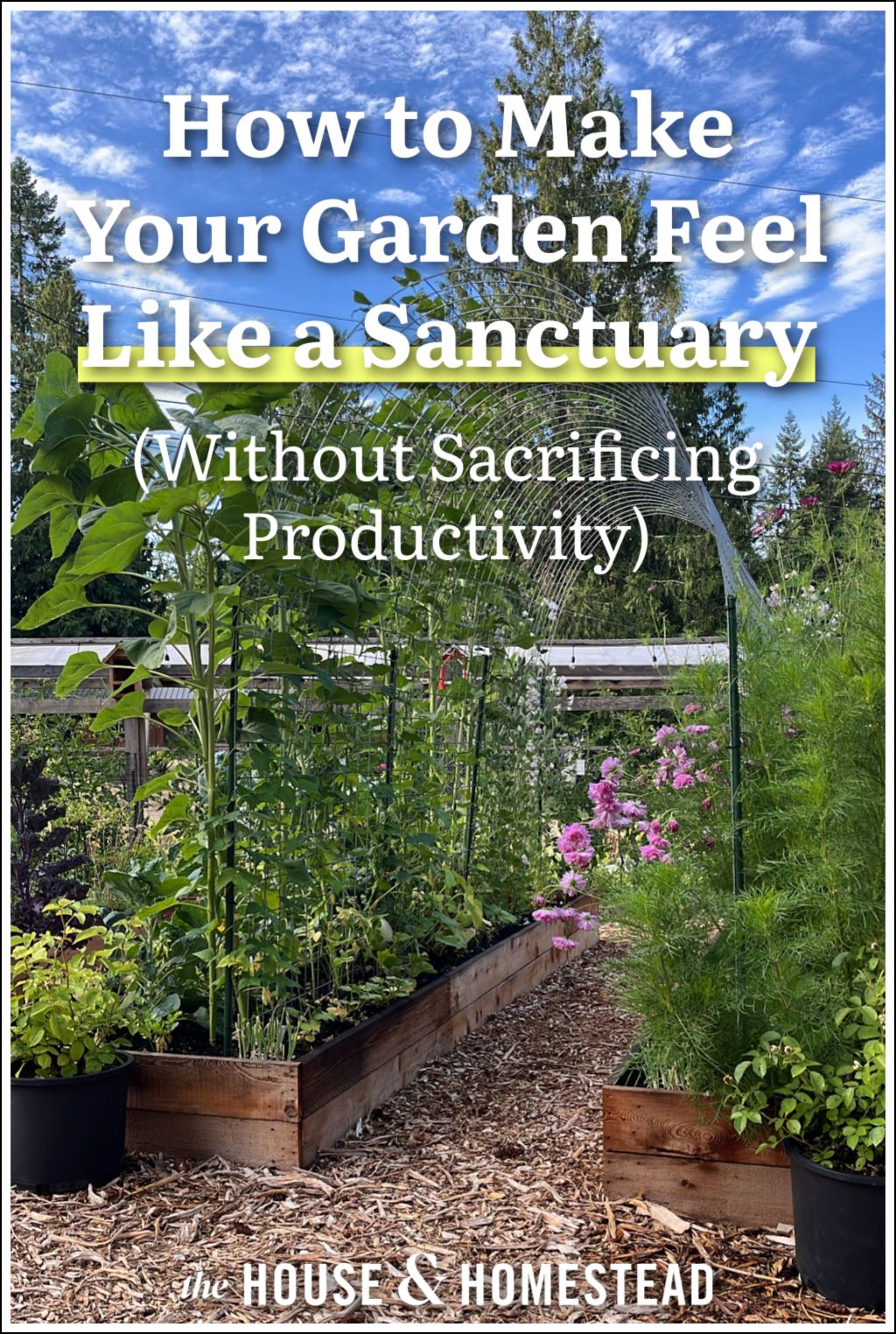
This year I’m growing a mixture of English shelling peas and sweet peas over an arched cattle panel trellis between two of our raised garden beds. The sweet peas are grown only for the flowers, which I enjoy both in the garden and as cut flowers in my home, while the English peas are grown primarily for food, but they naturally add beauty to the garden when they flower in late spring. Growing them over an arched trellis creates an aesthetic focal point in our yard that’s enjoyable to look at and to walk under. Plus, the flowers attract hummingbirds, bees, and butterflies to our yard.
Last year, I also grew giant sunflowers on one side of our arched trellis. The trellis helped provide support as they grew tall, and the sunflowers added beauty, height, and visual interest to the garden. The variety I grew was called Black Russian, and at the end of the growing season, we harvested sunflower seeds from the flower heads which we used to supplement our chickens diet all winter.
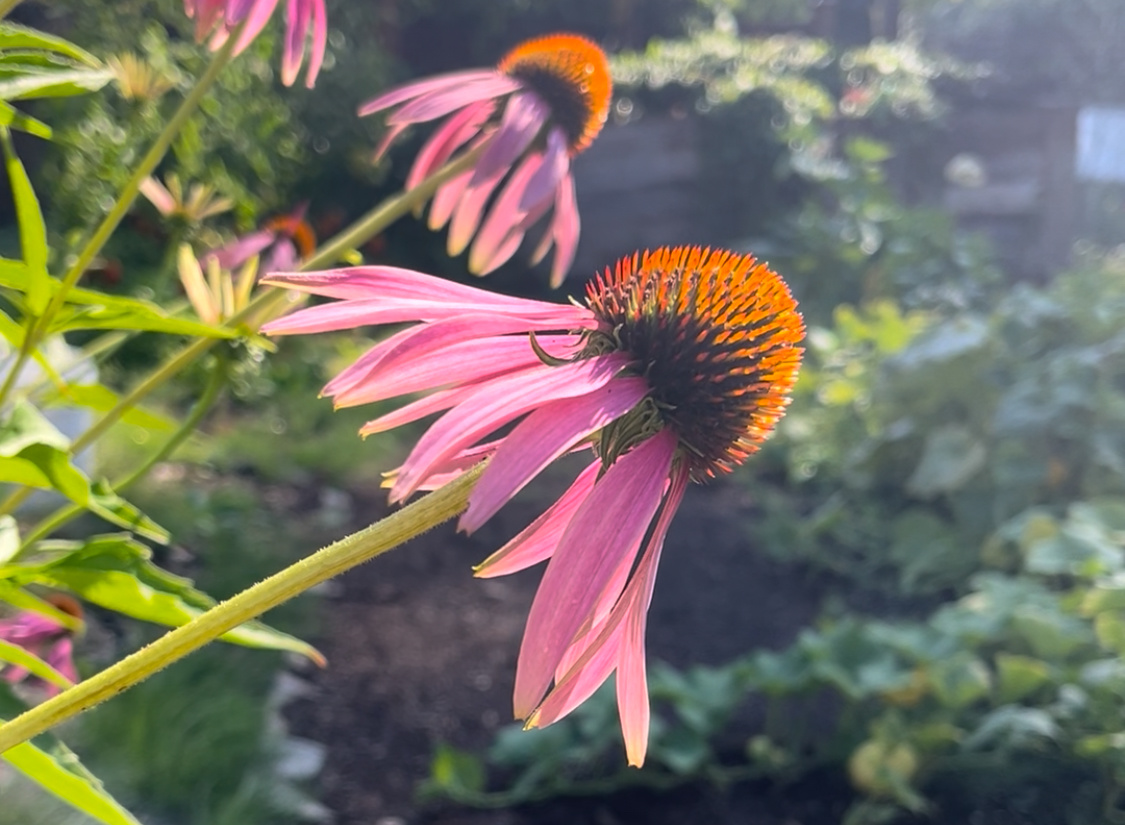
I’ve also been busy building out a medicinal herb garden with a variety of plants in one of our raised beds. Some are leafy plants (like mugwort, wormwood, comfrey and horehound). Others are grown for their roots (like burdock and horseradish). And some produce beautiful flowers (yarrow, feverfew, marshmallow, echinacea, valerian, calendula, and bee balm). Most are perennial too, or at least self-seeding, so I’ve been very intentional about where I’ve placed each plant, considering how they’ll look together once the plants are mature and the garden is fully grown in.
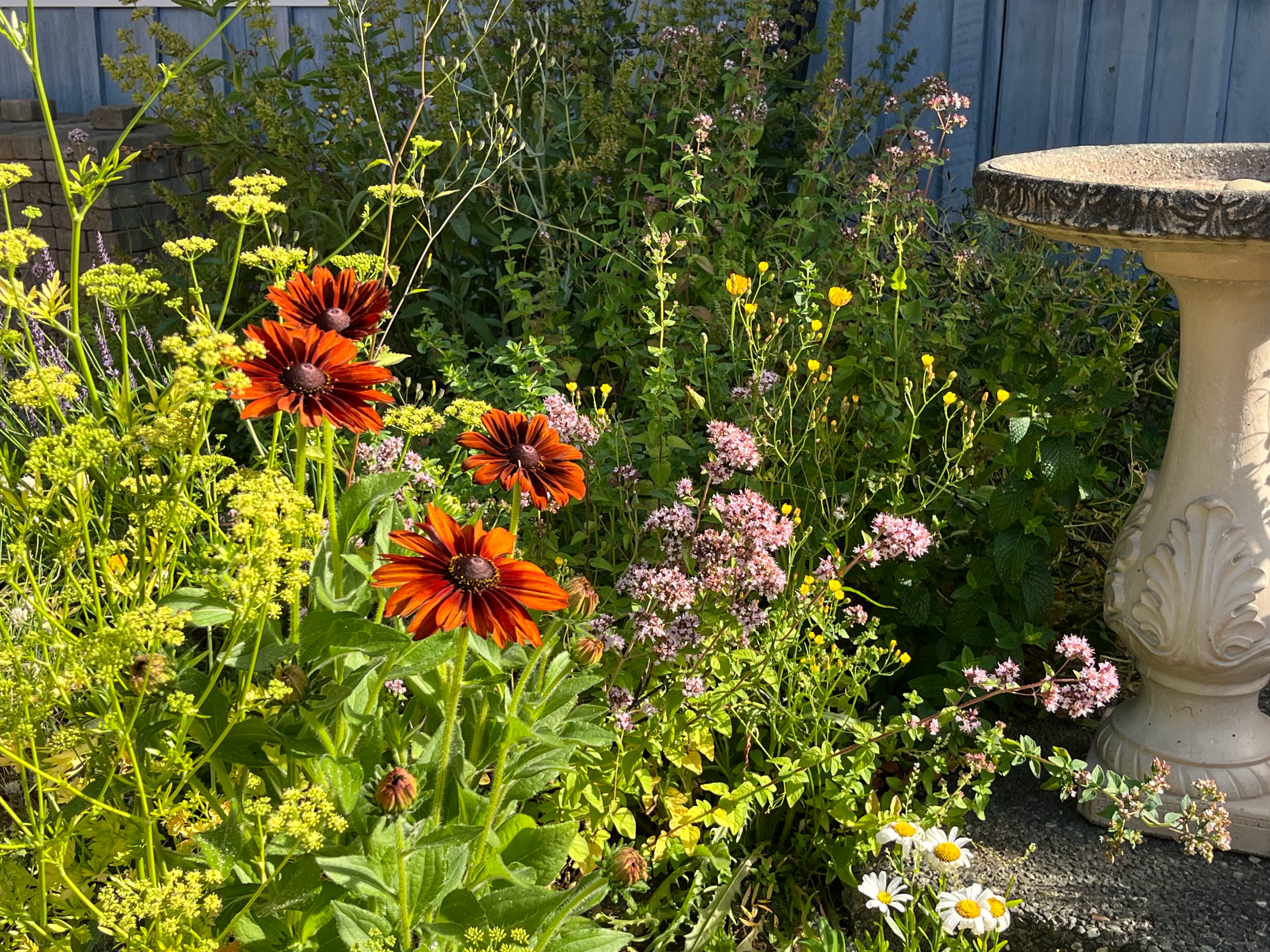
I’ve mixed the flowering plants with the leafier plants, and planted the taller plants like mullein and mugwort in the middle, with medium height plants around them and then the plants that grow lower to the ground and/or spill over the edge (yarrow, feverfew, horehound, comfrey, etc.) around the edges of the bed.
In our main vegetable garden, I grow mainly for production, so crops are grouped together in rows. But I always like to add a few flowering companion plants like marigolds and nasturtiums to the vegetable garden. Not only are they aesthetically pleasing, they also attract pollinators to the garden and offer other benefits, like repelling pests or acting as trap crops for things like aphids. Likewise, in our main culinary herb garden, I’ve mixed in flowers which makes it feel a little cottage garden-y and wild.
Here are just a few edible and medicinal plants that grow beautiful flowers and add visual interest to the garden:
- Bee balm
- Borage
- Blueberries
- Calendula
- Chamomile
- Echinacea
- Yarrow
- Lavender
- Nasturtiums
- Peas
- Pole beans
- Scarlet runner beans
- Apple trees
- Cherry trees
Add Flowers for the Sheer Beauty They Provide
When I first started gardening, the only thing I cared about was how much food I could grow and produce. I thought growing flowers just for beauty’s sake was a waste of space that could otherwise be dedicated to food production. My views have evolved over the years (as explained above), and nowadays I find myself growing more and more flowers simply because they bring me joy.
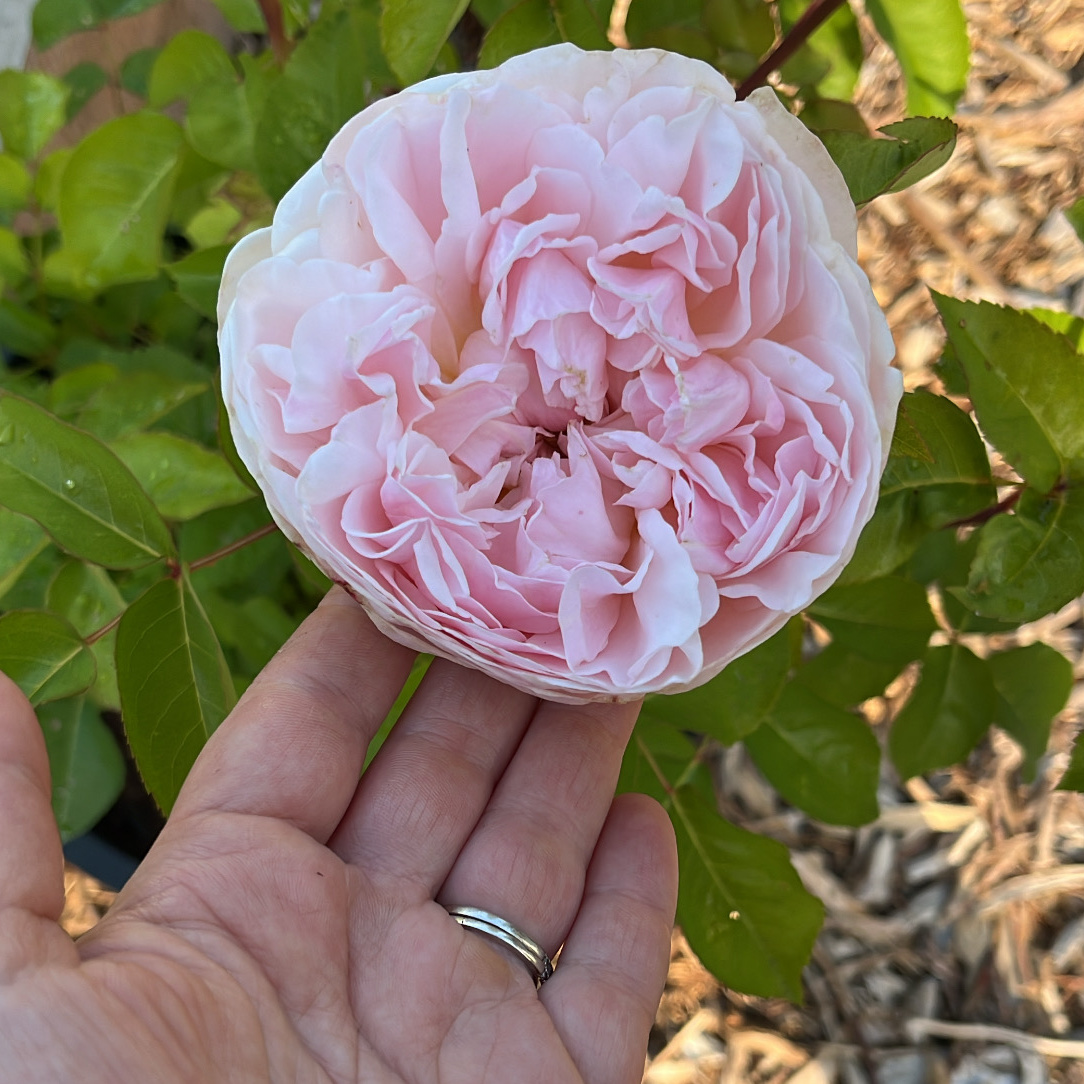
In fact, after much deliberation, I just decided to turn one of our beds into a flower bed instead of turning it into another strawberry bed. While I could almost double our strawberry production by growing strawberry plants in this bed, I decided that the enjoyment I’ll get from growing a cottage-style garden bed, complete with English roses, peonies, daisies, foxgloves, and other flowers with no edible or medicinal value was worth more to me than a few more pints of strawberries.
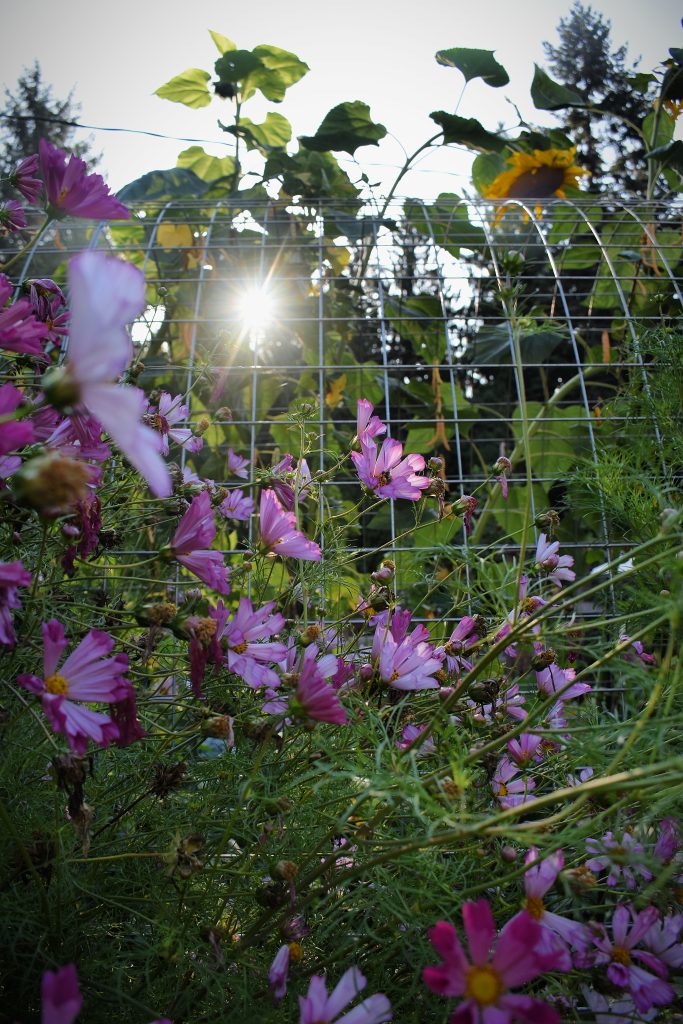
That being said, this garden bed also has a grape vine growing along the fence line behind it, and we’ll be planting an apple tree on the other side of the bed this year, all in an effort to continue blending food production with aesthetics in the garden. I also have an entire raised bed dedicated just to growing flowers. This is where I grow things like zinnias, dahlias, tulips, and cosmos, among other flowers.
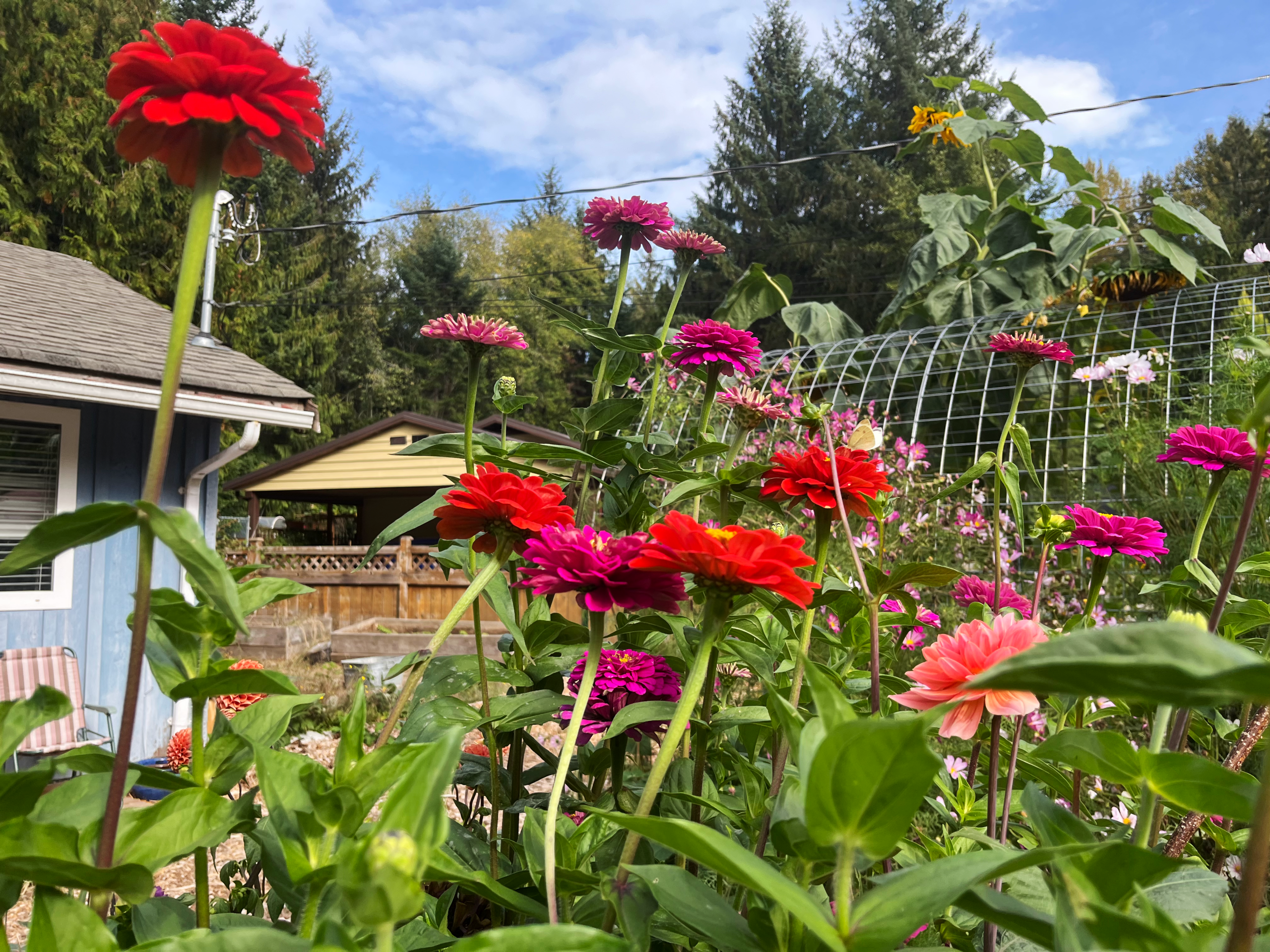
Adding a few fragrant flowers like roses, hyacinths, lilacs, and lavender also add to the sensory experience, and invite you to slow down and “smell the roses,” quite literally.
Here are some flowers that are worth adding to your garden just for the beauty and enjoyment they provide:
- Daffodils
- Hyacinths
- Tulips
- Lupins
- Foxgloves
- Hollyhocks
- Roses
- Peonies
- Lillies
- Daisies
- Black Eyed Susans
- Cosmos
- Dahlias
- Zinnias
Attract Birds, Bees, and Other Beneficial Critters
One of my favourite things to do is to simply sit in the garden, watching and listening to the soothing sounds of the birds, bees, and other beneficial insects and local wildlife that frequent our yard throughout the spring and summer months. It’s a simple way to enjoy the beauty of nature, and there’s something undeniably magical about watching bees move from flower to flower, seeing butterflies flutter and dragonflies dart through the garden, or hearing the unmistakable hum of a hummingbird’s wings just before catching a glimpse of it sipping nectar from a feeder.
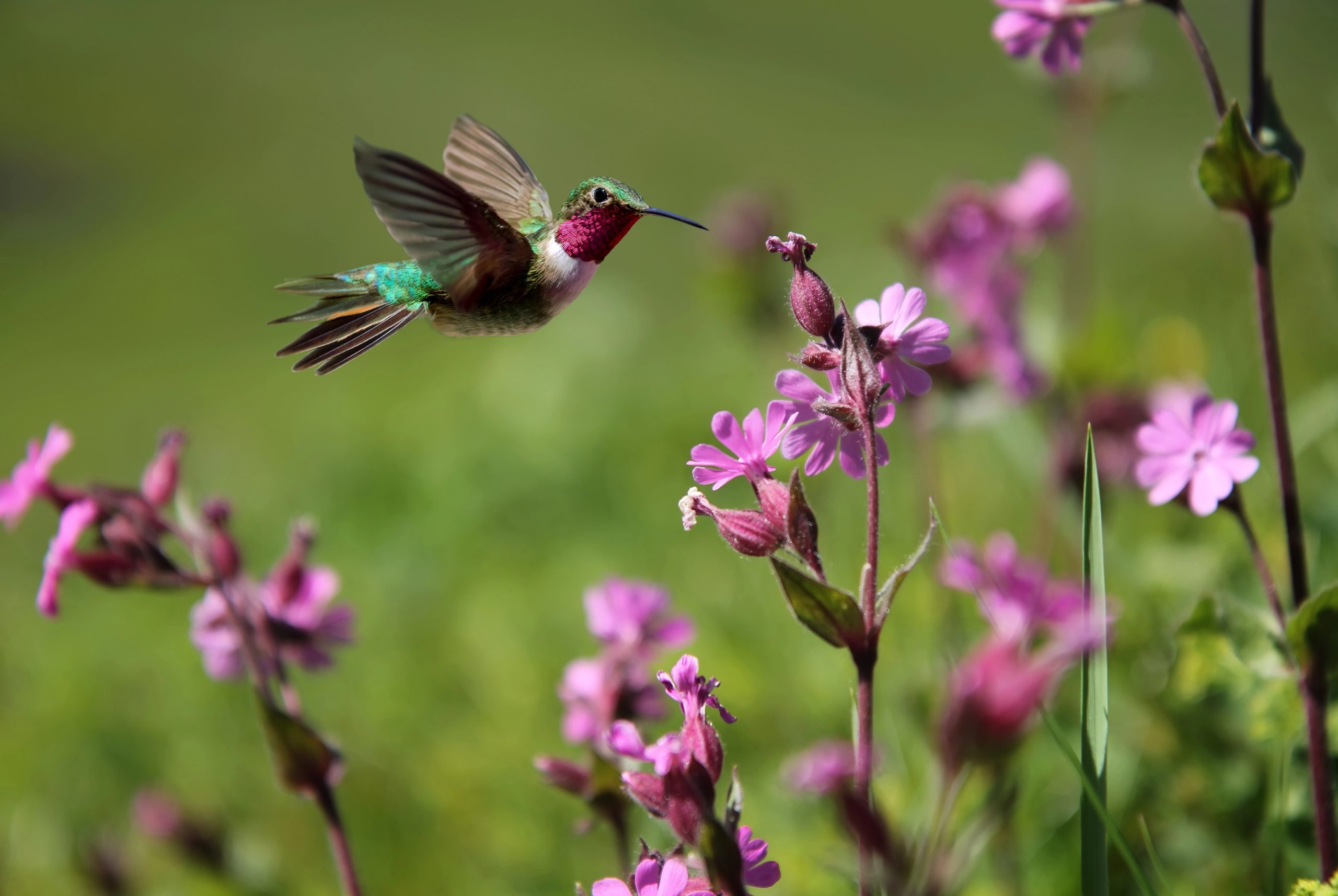
Robins, finches, and other wild birds are also welcome visitors. Ladybugs are both a treat to find in the garden and help with pest control, and our mason bees provide both entertainment and pollination each spring. And while I know not everyone is a fan of snakes, we have a nest of (harmless) garter snakes that live under our patio and can often be spotted slithering through the herb garden next to our house. Personally, I love spotting these snakes in the garden. They’re also great for pest control, and I find them whimsical as they slither through the patches of mint and oregano in our main culinary herb garden.
Here are a few of the ways we attract pollinators and other beneficial insects and critters to our garden, and how you can too! (Note that all of the following garden additions also add beauty all on their own:)
- Flowers
- Hummingbird feeders
- Bird feeders
- Water sources (like a bird bath or small pond)
- Native plants (for food and habitat)
- Mason bee houses*
*While cheap commercial mason bee houses can be purchased from many places, these houses can’t be cleaned out properly, which can lead to parasites and diseases infecting cocoons. We use mason bee houses with inserts that can be removed and cleaned, and have increased our “colony” from just a few dozen to hundreds of mason bees over the past few years. Check out this post for more info. on keeping mason bees in your garden.
Use Lighting and Other Decor to Create Atmosphere
I was recently reading through comments on a YouTube video on rising food costs, and someone shared that they were increasing their food production in their garden in response, while their neighbour was frivolously hanging strings of fairy lights in hers. It made me pause, and in some ways, gave me the idea for this blog post.
We have strings of lights in our garden, and they’re one of my favourite things about our outdoor space. I love the ambience they provide, especially at dusk at in the summer, while the crickets are chirping and everything is in full bloom—but also in the winter months, when they add light and visual interest to the dark days and nights. Plus, they provide light when we’re out working in the garden after dark (which happens surprisingly often), and add an extra sense of security to our home in the evening.
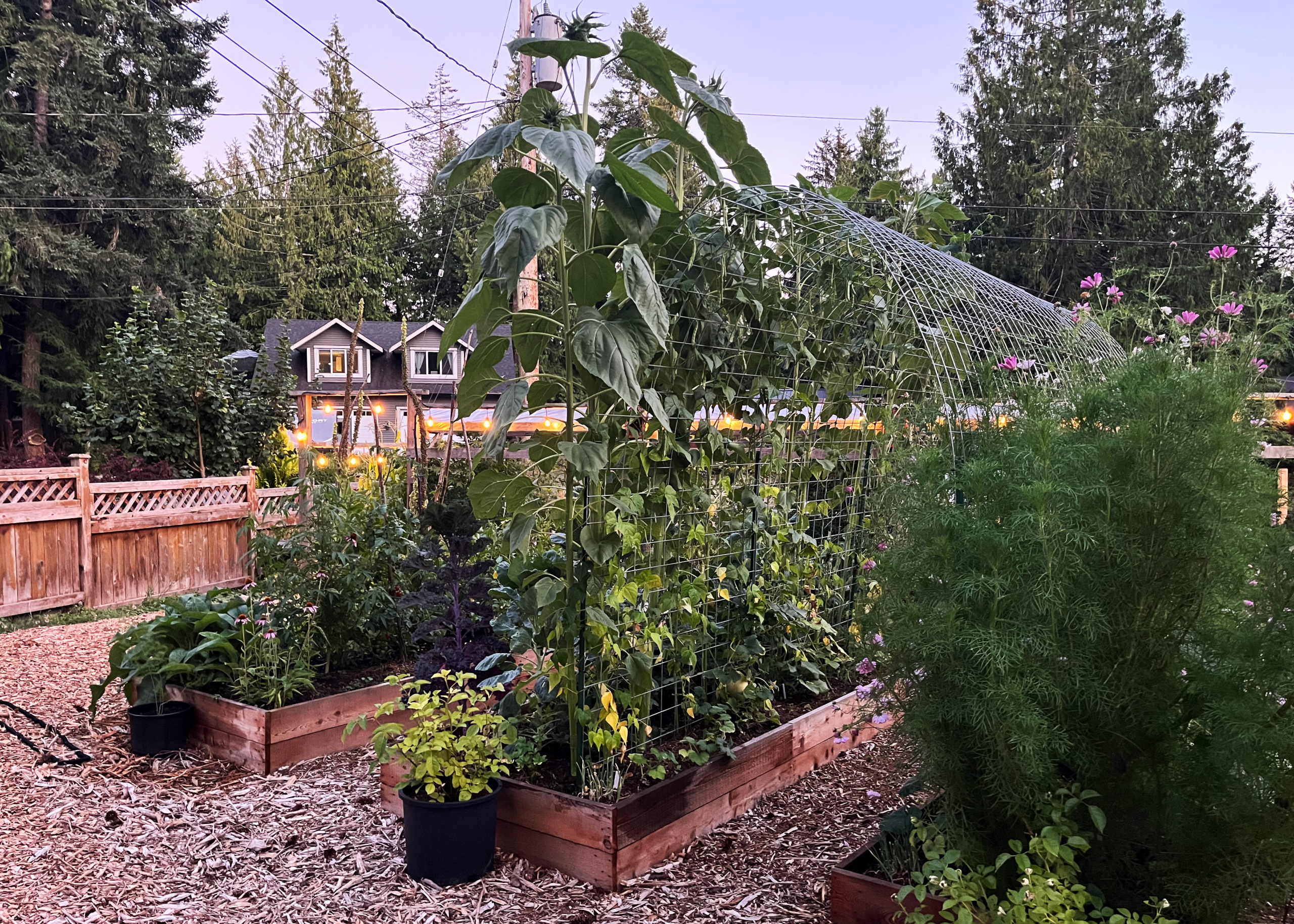
Like everything else I’ve mentioned so far, there’s nothing frivolous about adding string lights to your garden. Even if you grow only for production, a string of lights draped over your beds or around a fence are a great way to give your garden a literal glow up with the flip of a switch.
Likewise, other decorative elements like sculptures, water features, baubles, wind chimes, hanging baskets, decorative pots, and solar-powered garden lights can add interest and focal points to your outdoor space all year long.
Set Up Multiple Seating Areas
One of the simplest ways to make your garden feel like a sanctuary is to create places where you can actually stop and enjoy it. Too often, productive gardens become spaces we only enter to weed, water, harvest, and work. But when you add even a simple place to sit, the garden becomes somewhere you can be, not just somewhere you do.
If you have the space, consider adding more than one seating area throughout the garden. Different spots offer different experiences depending on the area, time of day, and season.
We have two Adirondack chairs on our front porch, beside our main herb garden that are great for enjoying a morning coffee or a refreshing beverage in the late afternoon sun at the end of a long day working outdoors. We’re also building a front porch, which offers a perfect vantage point of the garden and gets direct sunlight from early morning until late afternoon. We’ll build an arbour over top where we’ll trellis a grapevine for much needed shade (and food) in the summer.
We used to have a bench in our main garden, which was also a great spot to enjoy a coffee in the morning, or a cold beverage while working in the garden. But it inevitably ended up becoming a gathering zone for garden tools, seed pots, plant markers, soft ties, and other bits and bobs, so my husband turned it into a potting bench.
We also have a few backyard seating options: a bistro table and umbrella which provides us with a shaded area for dining al fresco we enjoy dining al fresco in the summer months, and comfortable seating around a fire table where we retreat after the sun goes down.
We also have a fire pit that we sit around and enjoy in the spring and fall before and after the local burn ban goes into effect. Multiple seating areas also encourage you to move through your space and appreciate your garden and property from different perspectives. I often find myself visiting the different areas on our property just for a change of scenery.
Incorporate Outdoor Games and Special Settings
Another way to make your outdoor space feel like a sanctuary is to treat it as a place for enjoyment, celebration, and connection—not just work.
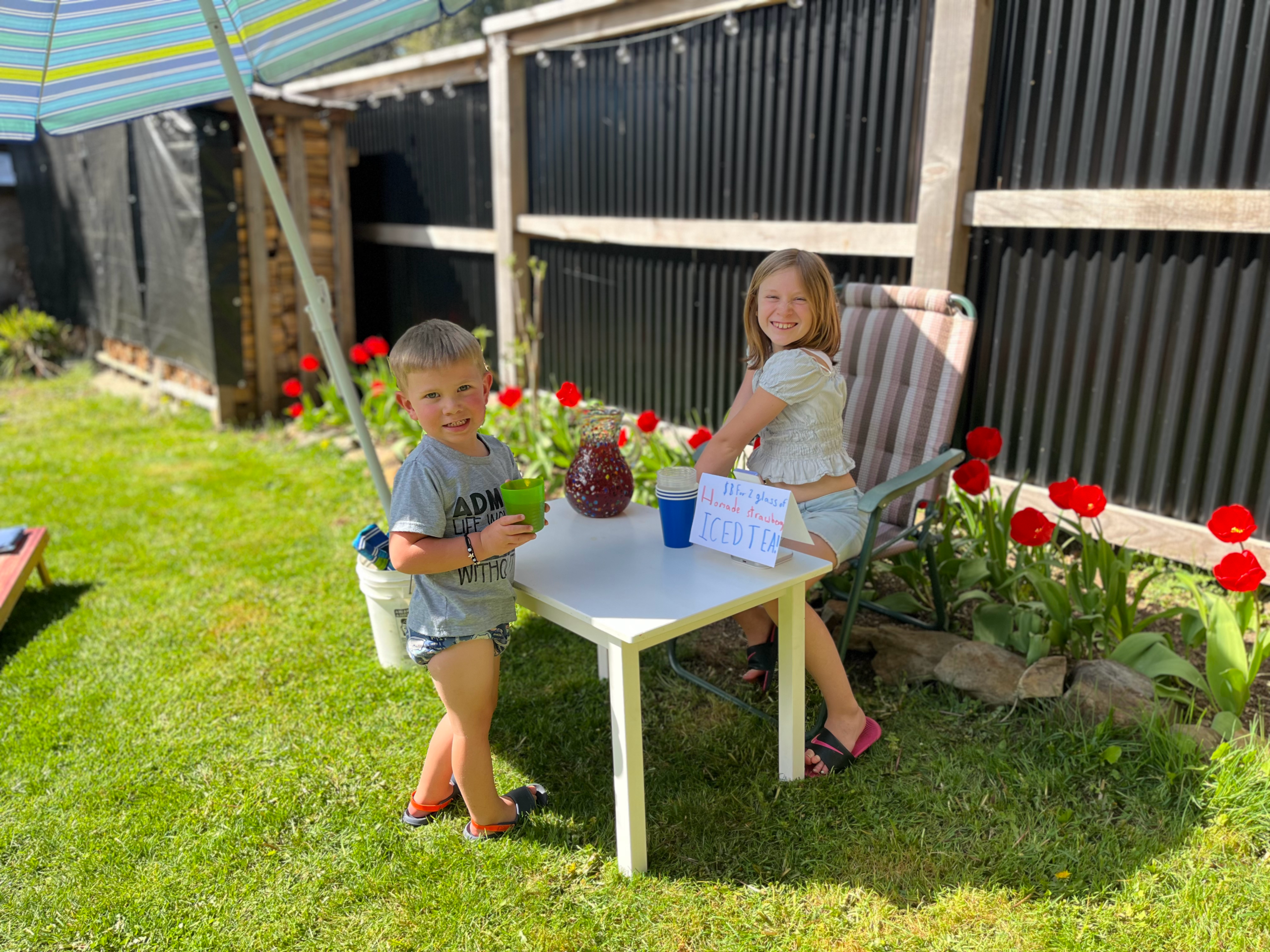
In the summertime, we set up a game of Cornhole in the backyard, which invites anyone passing through the yard to stop for a quick round of beanbag toss. We also break out giant Jenga on the deck and set up a water table and/or mini pool for the kids.
We also like to have picnics in the backyard, set up the tent for campouts, and break out the projector for summer movies on the deck. We even set up a “backyard brewery” for Father’s Day last year, which not only transformed our yard into a place our family was excited to spend the day, but attracted a few other dads to our yard as well!
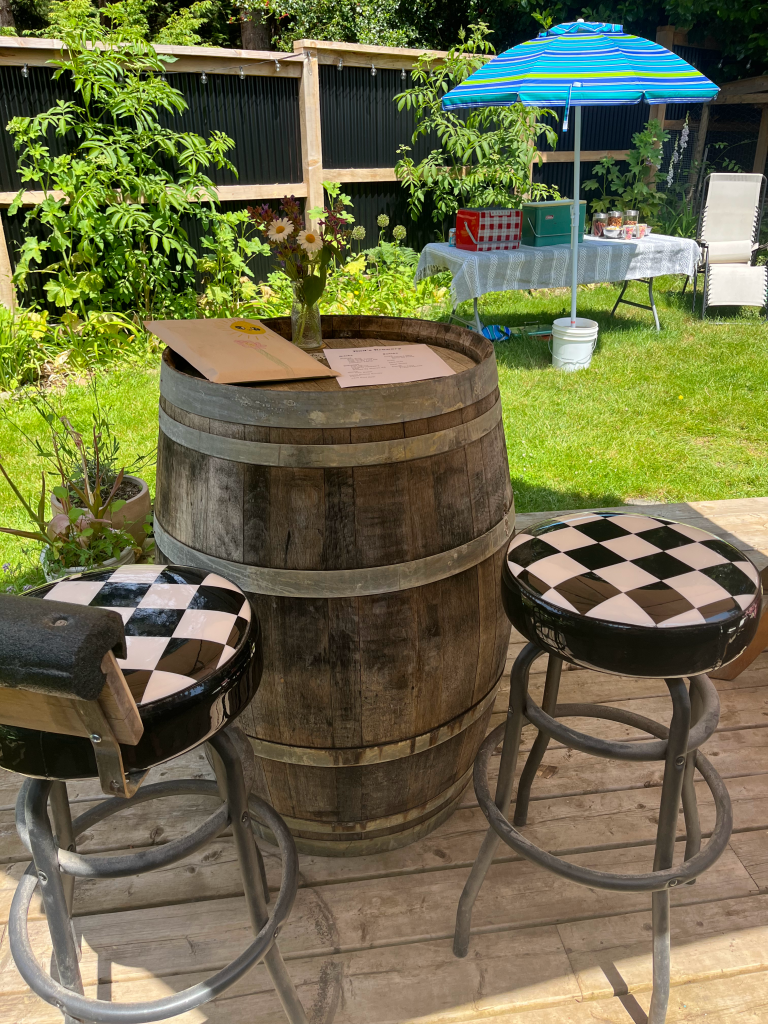
While we tend to set up games and little gatherings in our backyard rather than the front garden, the idea is the same: it’s a meaningful way to bring life, joy, and connection into your outdoor space. And whether it happens in the backyard, side yard, or even a tucked-away corner of the garden, it all contributes to making your property feel like a sanctuary.
Create a Space You Want to Spend Time In
At the end of the day, what makes an outdoor space a sanctuary isn’t just how it looks or how much it produces—it’s how much you want to be in it.
A productive garden can absolutely feed your family and support your homestead goals, but if it only feels like another item on your to-do list, you miss out on one of its greatest gifts. The goal is to create a space that naturally draws you outside and makes you want to spend time there, not because something needs doing, but because you genuinely enjoy being there.
The more inviting your yard and garden becomes, the more you’ll naturally spend time in it.
And the more time you spend in it, the more at peace you’ll likely feel.
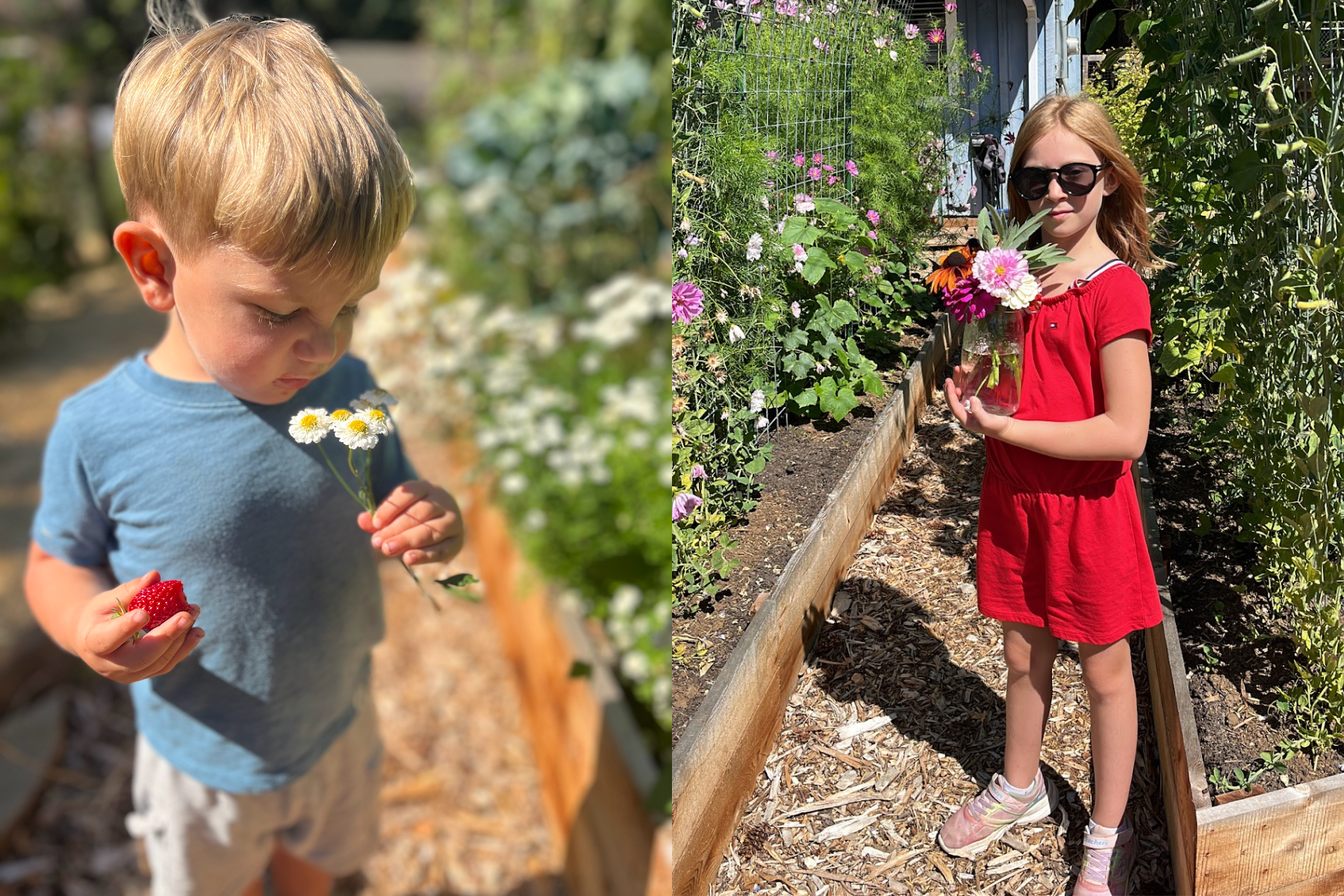
In a world the feels more rushed, more obnoxious, more uncertain, and more anxiety-inducing with each passing day, creating a garden space that feels like a sanctuary offers us a place to slow down, escape the noise, ground yourself, calm your mind, and reconnect to the natural world and to yourself.
Whether you have multiple acres or just a small balcony, you can incorporate the tips shared here to turn your outdoor space into a place of beauty and productivity that feels like your own personal retreat from the world.
Your garden doesn’t have to only be a place of labour and productivity. It can also be the place where you breathe deeply at sunrise, listen to bees in the afternoon, and watch the light fade after a long day’s work.
So grow the vegetables. Plant the herbs. Fill the pantry. But make room for beauty and enjoyment too, because a garden that feeds your soul is just as valuable as one that feeds your body.
What other tips do you have for making your garden feel like a sanctuary?
Share your thoughts and ideas in the comments below!






0 Comments