


 This spiced plum jelly makes quick and easy use out of fresh plums without having to pit them. The final product is a beautiful purple, sweet, spiced plum jelly that tastes like what cozy feels like. Amazing on toast, over ice cream, or straight out of the jar. It also makes an excellent Christmas gift!
Visions of plum trees from long, long ago
I remember my grandpa having a plum tree when I was growing up. My grandpa (Poppy) was the first gardening mentor in my life. He kept a veggie garden out back where I remember digging my hands into the dirt and pulling worms out, exploring the natural world and learning about where food came from for the first time. Poppy also had an apple tree and a plum tree. For whatever reason I remember the plum tree best, and when Poppy died, I wrote a story about him and his garden and his plum tree affectionately titled “The Smell of Dirt.” I always vowed that when I had my own house I would grow a plum tree in honour of him.
Fast forward to today: We finally have a home of our own, but we can’t plant fruit trees here because we have two septic tanks taking up space in the front yard. Oh well. One day we will have our plum tree, I swear. The good news is that I can still get my hands on fresh plums for free from around the Valley where we live. Lots of fruit trees with fruit that people that don’t want around here! If you like, you can read more about how I get my hands on free organic food (that I don’t grow myself).
Process plums right away for best results
Ripe plums need to be processed pretty much right away to retain the best quality. They go mushy really quickly. A few years ago, we lost pounds of plums to fruit flies before we had the chance to process them. If you need to hold onto them for any length of time, make sure they go in the fridge as soon as possible. When we used to pick fresh plums at our neighbour’s house in the late summer, they had a variety of clingstone plums that were delicious but a pain in the you-know-what to pit and process, so I needed a recipe that didn’t require me to pit them all, and could allow me to process them quickly before the fruit flies got to them!

This is an old photo of my daughter when we lived at our old house and used to pick the neighbour’s plums!
The easiest, yummiest way I could think of was to make plum jelly. I’m a fan of using the whole fruit when making preserves, so I’m usually an advocate for homemade jams. But jelly (which uses just the juice from the fruit) is a great option if you’re working with a fruit that you don’t want to pit. It made processing the remaining plums super quick and easy.
All I did was throw washed, whole plums into a large pot, add water, cook them down and mash them up into a pulpy liquid. Then I strained the liquid through several layers of cheesecloth to get rich, pure plum juice.

Throw the plum juice back into a clean large pot and add a generous amount of sugar and some spices. Bring to a boil, add liquid pectin and pour into jam jars! In the end we got about 36 4oz jars of plum jelly. We gave 6 to our neighbours as a thank you and have the rest stored away in the pantry for winter.
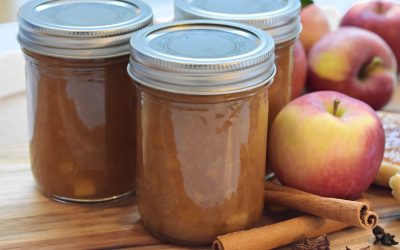
Well, we may be on our second jar already, but that’s the beauty of preserving at home: You typically get big enough batches to last the year through and maybe even longer, and all for next to no money if you grow your own. This beautiful, glassy, purple-coloured plum jelly is spiced with cinnamon, nutmeg and cloves. This gives it a cozy, Christmas-y flavour, which also makes it a perfect Christmas gift! Because of the long shelf life of plum jelly, part of our Christmas “shopping” is already done.
Another awesome benefit to home preserving:) And for me, every time I get a taste of plum jelly, I think of that big ol’ plum tree in my poppy’s backyard. I’m reminded of him, the beautiful plums he grew, and the smell of dirt that I’ve grown to love so much, and I smile.

Spiced Plum Jelly
Ingredients
- 4 cups plum juice (the amount of fresh plums you'll need will depend on the type of plums you are using. We used black plums, and we got about 1 cup of juice per pound of plums. Blue plums are slightly larger and meatier so you will probably need slightly less to to make each cup of juice).
- 6 ½ cups of sugar
- 1 Tbsp ground cinnamon
- 1 Tbsp ground nutmeg
- 1 tsp ground cloves
- 1 pouch liquid pectin
Instructions
To Make the Juice
- Place whole, washed fresh plums into a large pot. Add ½ cup of water for every pound of plums.
- Bring to a boil over high heat, stirring frequently and mashing the plums up as much as possible to extract the juice (I use a potato masher).
- Reduce heat, cover and simmer on medium heat, stirring and mashing plum mixture occasionally. Simmer for about 20 minutes.
- Fold a large piece of cheesecloth 3 times (so there are 3 layers of cheesecloth to strain liquid through) and place over a colander. Place colander in a large pot or bowl for the liquid to strain into.
- Transfer plum mixture to the cheesecloth-lined colander and allow liquid to strain through into the large pot or bowl. Squeeze mixture through the layers of cheesecloth occasionally to help extract the liquid. Allow plum mixture to strain for about 2 hours, then removed colander, cheesecloth and solids and discard (solids leftover from plums are great for the compost!)
For the Jelly
- Prepare water bath canner, jam jars and lids: Inspect jars to ensure there are no nicks or cracks in the glass, especially around the jar rim as this can prevent a proper seal. Wash jars and bands in hot, soapy water, rinse and then sterilize by simmering in water over medium-high heat, either in a canner or large pot with a rack in the bottom on. Leave jars in simmering hot water until ready to fill. Sterilize new lids in a bowl of hot water.
- Measure out 4 cups of the plum juice for the first batch (do not do a double batch when working with liquid pectin as it can affect the set).
- In a large stainless steel pot, combine plum juice, white sugar and spices (spices mix best when you use a whisk to mix them in).
- Stirring constantly, bring mixture to a full rolling boil that cannot be stirred down. Add entire pouch of liquid pectin and boil hard for 1 minute while stirring constantly. Remove from heat and skim off foam from the top.
- Pour hot jelly mixture into sterilized hot jars leaving ¼ inch headspace. Wipe rims and place lids and bands on jars, tightening bands to fingertip-tight (tight enough that resistance is met but not so tight that air can't escape when canning).
- Place jars in water bath canner making sure they're completely covered with water. Bring to a boil and process for 10 minutes. After processing time is up, remove canner lid and wait 5 minutes before removing jars. Allow to cool completely at room temperature and then store in a cool, dark place.
Wishing you homemade, homegrown, homestead happiness :)

Wanna learn how to can your own food?
Whether you’ve never canned anything before or you’ve done a little home canning and you’re ready to take the next step, my Yes, You CAN! complete home canning course will walk you through everything you need to know to get started canning food SAFELY at home.
Over the course of 12 easy-to-follow lessons, we cover both water bath canning and pressure canning, and I show you step-by-step how to can your own jams, jellies, pickles, pie fillings, fruits, vegetables, tomato sauce and chicken stock at home. And of course we’ll go over safe canning practices, equipment and over all best practices in more depth so that you always feel confident both during the canning process and while enjoying your home-canned food afterwards.
You’ll also get a collection of bonuses including:
- Printable checklists and cheatsheets to help you stay safe and never miss a step while canning food at home
- My bonus Jam and Jelly Making Mini-Course to help you make and can your own jams and jellies with store-bought pectin, no pectin and even low-sugar
- A copy of my Home Canning Handbook, complete with 30 of my favourite home canning recipes for canning everything from fruits and vegetables to jams and jellies to sauces and salsa to stocks, soups, meats, combination meals and more!
If you’re ready to get started home canning (or canning more food than ever before this year!) enroll now and get started stocking your pantry!
Related Posts:
- Low-Sugar Strawberry Jam with Pomona’s Pectin
- Low-Sugar Mango Jam Recipe
- Pectin-Free Strawberry Jam Canning Recipe
- Water Bath Canning for Beginners
- 6 Canning Safety Rules You Must Follow
- Botulism & Home Canning: What You Need to Know to Stay Safe



Does it take a while for the jelly to set up? I still have semi thick juice almost 24 hours later.
Hi Lisa,
If you followed all the directions exactly, it should set in 24 hours although sometimes jellies can take longer to set. Sometimes they can be tricky -if you let it boil too long or not enough once the pectin is added, or you jostle/move them before they fully set – that can disrupt the pectin from setting up properly.
I have had jellies that did not set only a few times (in my more than 2 decades of making them). They were completely different recipes from this one but once I think I mixed up my pectins — I was making two different small batch jellies at the same time (that used different types of pectins). So using a pectin that is different than what the recipe calls for can do that also. But I ended up using them as a sauce/syrup which actually worked out well. It is never a loss or a failure because you can still use them.
So, I would give it a little more time to see if it will thicken more for you. Otherwise, label it as a sauce or syrup instead of jelly and use it like that on waffles, pancakes, ice cream, or whatever else you’d like.
I hope this helps. The last time this happened to me it was my apple jelly and I just used it as a syrup. It worked really well when I used it as the sweetener in homemade granola and also as a topping on ice cream and pancakes. It was a nice switch from our usual maple syrup. 🙂
I also wanted to let you know an easy way to out the plums. If you notice they have a small indent on one side, cut the opposite side (basically turn plum a quarter of a turn. Cut all the way around, twist plum, twist pit out, and you’re done.
I’ll have to try that. Some plums are easier to pit than others. Like freestone vs. clingstone peaches, plums can either be easy to pull away from the pit or they can hold on for dear life! The variety I was using here were of the latter kind (not sure what type exactly as they were from my neighbour’s tree). But I will try your tip next time for sure!
Instead of throwing out all the plum pulp, I realized it was the consistency of applesauce so I added sugar and the same spices in recipe to make spiced plum sauce. I didn’t measure the sugar or spices, I just kind of went by taste and water bathed jars for approximately 15-20 minutes according to what ball does for applesauce.
Oh good idea! I made plum sauce before but went through the process of pitting them all which was not fun. These particular plums were tough to pull the flesh away from the pit. So it took forever and a day to pit them and turn the flesh into plum sauce. But the jelly made quick work of using up the rest of them. How did your plum sauce turn out? I wonder if it is as flavourful since much of the juice has been strained out? I’d love to know how it tasted in the end! Feel free to send a jar my way;)
I would like to try this recipe but I only have the powder pectin. Will it work with the same ratios?
Hi there!
It is possible to substitute powdered pectin in this recipe, however the ratios would be slightly different. Instead of 4 cups of plum juice and 6 1/2 cups of sugar, you would need 5 1/2 cups of juice and 7 1/2 cups of sugar. Also, you would add the powdered pectin right at the beginning with the spices but DO NOT ADD SUGAR until later. Be sure to whisk really well to help the powdered pectin dissolve. Then, bring all ingredients to a boil and add the sugar all at once. Boil hard for one minute, stirring constantly, and then pour into jars. I hope this helps! I’d love to know how it turns out with powdered pectin! I’ve adapted these recipes from the Ball Complete Book of Home Food Preservation so the juice/sugar/pectin ratios are tested. Often jellies are made with liquid pectin simply because it does not need to dissolve like powdered pectin so gives a nice, clear-set jelly. But as long as you whisk in the powdered pectin really well it should turn out the same. Let me know how it goes!